
Custom Jewelry Wholesale Lead Times Converted to Weeks
Three published windows decide when a custom jewelry wholesale order lands: 3D CAD back inside 48 hours, sampling at 25–30 days, and production at 3–4 weeks. Written in the same unit, that is roughly 0.3 weeks of design work, 3.6–4.3 weeks of sampling, and another 3–4 weeks of production. Converting all three into weeks is the fastest way to see where a launch date is won or lost.

Key takeaways
- 3D CAD lands inside 48 hours; the master sample takes 25–30 days, which is 3.6–4.3 weeks.
- Mass production adds 3–4 weeks after the sample is approved, so a first order spans about 7–9 weeks.
- The minimums are 50 pieces in the silver line, 100 pieces in artisan brass and 100+ pieces in the stainless line, for each design, which means a two-design range starts at twice those numbers.
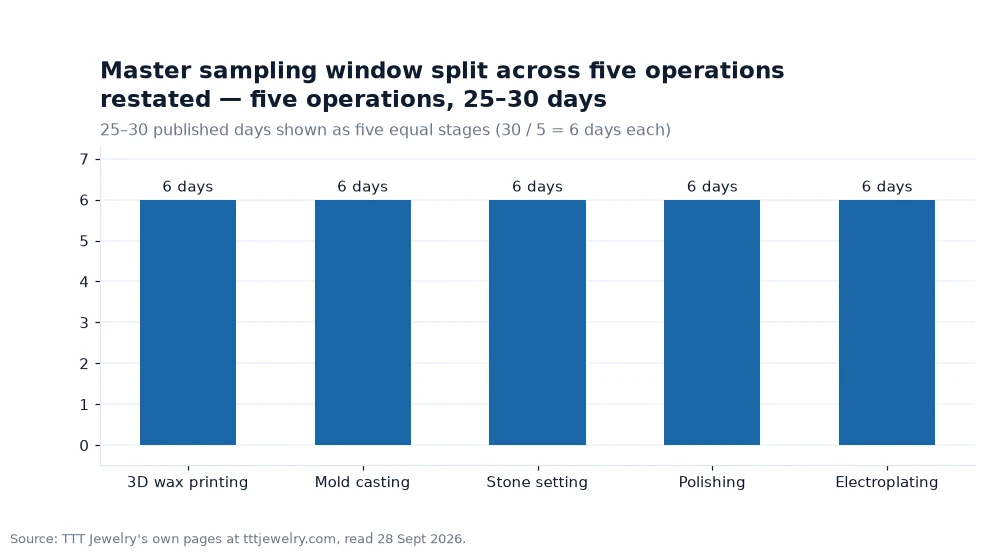
- Five named sampling operations share that 25–30 day window, so each bench holds a 5–6 day slice.
Why a wholesale calendar reads better in weeks
Every maker that produces jewelry for other brands publishes the same three numbers, and they run on different clocks. CAD is quoted in hours because it happens on a screen. Sampling is quoted in days because a piece moves through five benches. Production is quoted in weeks because it depends on batch volume and on how complicated the design turned out to be.
Weeks also match the way you actually buy: against a trade show date, a photoshoot, a retail season, a reorder trigger. A twenty-five day quote and a thirty day quote sound interchangeable until you write them as 3.6 and 4.3 weeks and lay them next to a calendar with fixed dates printed on it.
The three published windows, restated
The figures published by the manufacturer are a CAD stage of under 48 hours, a master sampling window of 25–30 days, and mass production of 3–4 weeks once the sample is signed off. As weeks: under 0.3 weeks, 3.6 to 4.3 weeks, and 3 to 4 weeks.
Chained end to end, an approved drawing reaches a packed carton in roughly seven to nine weeks for a first order. That chain assumes nobody waits on a render approval for a fortnight, and it excludes freight and destination clearance.
What the sampling weeks are actually spent on
The published sequence names five operations inside the sampling window: the 3D wax print, mould casting and stone setting, then bench polishing and custom plating. Each is a bench with its own queue, and each has to finish before the next one starts on any given piece.
That sequence rewards one habit above all others: freeze the design before wax printing begins. Moving a stone after casting has run means the later operations repeat, and repeating three benches is not a small edit.
Where a schedule quietly gains weeks
Very little slips because a factory decides to slip. It slips because an approval email sits unread, or because a stone choice changes in week two. The published service standard is a 24-hour response and one dedicated project manager per account, which exists exactly because the gates, not the benches, are the slow part.
Freight and customs then sit outside the production window altogether. A nine-week plan that stops at the factory gate is a plan that will look wrong in week eight, however well the sampling went.
One more source of drift deserves naming: the master sample itself. It travels by courier twice, out to you and back if a change is agreed, and each leg sits outside every published window. Budget the approval slot as calendar time rather than factory time, and it stops turning up as a mysterious two-week gap in the middle of an otherwise tidy plan.
Reading a schedule before you commit to tooling
Ask for the three windows as dates rather than durations, then ask which of the five sampling operations happen under the factory's own roof. A maker with its own mould room and plating tank can move one stage without moving the whole chain, and that flexibility is what you are buying when a search for a jewelry wholesale manufacturer China directory listing leads you to a workshop instead of an agent.
The final published gate is inspection: 100% of pieces are checked before packing, and it appears in the step list as a stage in its own right rather than a parting glance. Put a buffer around the approve-to-production handoff and the rest of the calendar behaves.
The eight factory steps behind the three windows
Sampling is not the only sequence running. The factory publishes eight production steps — a design drawn by hand and in CAD, a prototype made by mould or 3D print, the sprue cut away, gloss polishing, brushed and textured surfaces, plating, a final inspection, then delivery — and on a custom order several of them run twice, once for the master sample and again for the bulk run.
That repetition is why a repeat order is faster than a first one. The mould already exists, the surface finish has been agreed, and the plating recipe is on record, so the second pass through those eight steps begins from a known specification instead of a discussion. Only the first order pays the full sampling cost in calendar time.
The step buyers underestimate most is sprue cutting, where a cast piece is separated from its feed channel and cleaned before finishing starts. It is unglamorous work and it is where a bad casting shows up, which is far preferable to finding it after plating has sealed the surface.
The wholesale line publishes its own service flow, and it is five steps rather than eight: concept and design, master sampling, quality inspection, sample confirmation, then mass production. The durations sit inside those steps — the CAD stage inside concept and design, the 25–30 day window inside master sampling, the 3–4 week run inside mass production.
The step most buyers leave out of their own planning is sample confirmation, where the physical master sample is sent for a final sign-off. It is the gate that turns a calendar into a commitment, and it is also what produces the benchmark for every later order: the published aim is that batch #10 matches batch #1, on the same material sourcing and the same surface standard.
| Stage | Published window | In weeks |
|---|---|---|
| 3D CAD modelling and renderings | under 48 hours | under 0.3 weeks |
| Master sampling (wax to plating) | 25–30 days | 3.6–4.3 weeks |
| Mass production after approval | 3–4 weeks | 3–4 weeks |
| Final inspection before packing | 100% of pieces | inside the production window |
Worked example: splitting 30 days across five benches
Take the published sampling window and divide it by the five operations the factory names. At the slow end, 30 ÷ 5 = 6 days per bench. At the fast end, 25 ÷ 5 = 5 days per bench. The realistic allowance per operation is therefore five to six days, and that division is my arithmetic, not a published figure.
The consequence is uncomfortable in a useful way. A design change that adds a second setting pass does not add a day or two, it adds a five to six day slice to the critical path. Two such changes turn a four-week sampling window into a five-week one.
Frequently asked questions
How many weeks is a 25–30 day sampling window?
Between 3.6 and 4.3 weeks. Divide the days by seven: 25 ÷ 7 = 3.6 weeks and 30 ÷ 7 = 4.3 weeks.
Does mass production ever start before the sample is approved?
No. The five sampling operations end with a physical master sample that you approve, and only then does the 3–4 week production run begin.
What is the smallest order that can be placed?
Published minimums are 50 pcs in 925 silver, 100 units in eco-brass and 100 plus in stainless steel, per design quoted per design.
Turning those weeks into a purchase order
The conversion fits on one line: under 0.3 weeks of CAD, 3.6–4.3 weeks of sampling, 3–4 weeks of production, plus your own approval time at every gate. What a buyer needs beyond arithmetic is a straight answer on which of those zones overlap and which operations the factory owns end to end — the OEM/ODM process breakdown shows where a brand's own CAD files slot in and where co-development starts instead.
If the first order is a plated fashion piece rather than a precious metal one, read the factory step list before the sample is booked, because the plating stage is what decides how a bracelet still looks after a summer of wear.
The list this piece builds on — the five-step service flow and the six customisation variables and the packaging set — is listed at the supplier's own site on tttjewelry.com, read 28 Sept 2026. MOQ figures are quoted per design there. My re-orderings of the published facts are mine [1]