
Launching a Value Private Label Fragrance Line: A Buyer's Decision Framework
A value private label fragrance line succeeds or fails on five decisions, and four of them are made before a factory is chosen. How much of the scent is genuinely yours, how much stock you are willing to hold, which market you launch into first, how the packaging is sourced and what the line is expected to earn per unit. Get those wrong and the cheapest quotation in the inbox will still produce an expensive programme. The framework below is ordered so that each decision constrains the next, which is how the cost of a value line is actually determined.
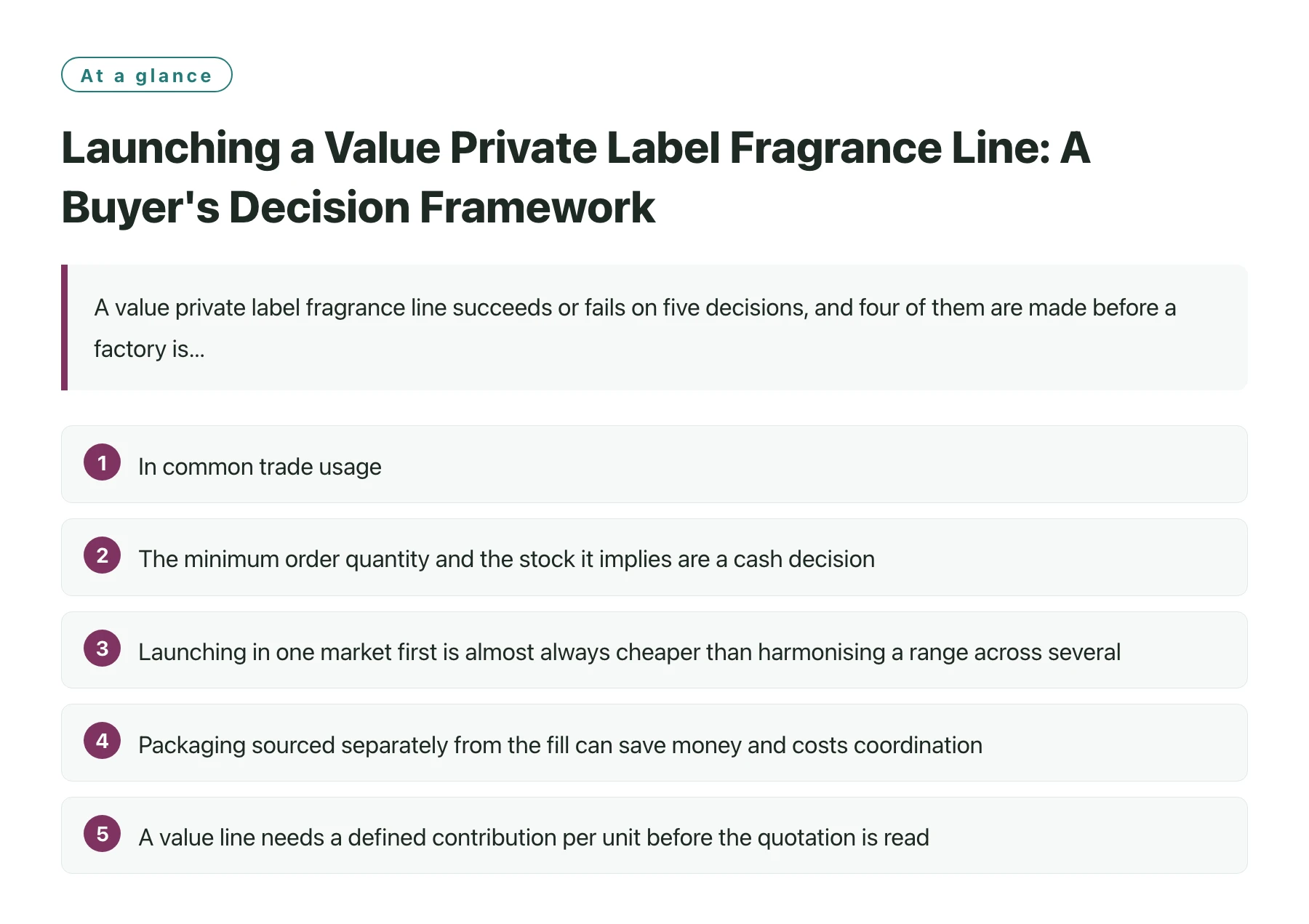
Key takeaways
- In common trade usage, private label means your brand on a formulation the factory already holds or adapts, which is fast and affordable but limits how unique the scent can be.
- The minimum order quantity and the stock it implies are a cash decision, not a production detail, and they usually set the true ceiling on a value line.
- Launching in one market first is almost always cheaper than harmonising a range across several, because declaration and documentation work scales with markets, not with units.
- Packaging sourced separately from the fill can save money and costs coordination, especially where the supplier does not handle decoration or assembly.
- A value line needs a defined contribution per unit before the quotation is read, otherwise every quote looks acceptable and none can be compared.
Private label is often described as the fast route to market, and it is, within limits. The limit is that the scent is not exclusive to the brand in the way a developed fragrance is. Two brands can end up selling recognisably similar products, and the difference between them lives in packaging, story, channel and price rather than in the fragrance itself. For a value line, that is frequently an acceptable trade; the mistake is to pay for exclusivity you are not getting, or to assume exclusivity you never bought.
The framework below treats the launch as a sequence of constraints rather than a list of tasks. Each decision narrows what the next one can be, and the order matters because the expensive decisions are the hardest to reverse.
Five decisions that shape a value private label line
| Decision | Option A | Option B | How to decide |
|---|---|---|---|
| How much of the scent is yours | Private label: an existing or lightly adapted composition | Developed or ODM: a composition built or substantially adapted for the brand | Decide whether the scent is the brand's promise or one feature among several |
| How much stock to hold | A larger first run at a lower unit cost | A smaller first run at a higher unit cost with faster reordering | Compare the cash tied up in stock against the risk of a sell-out or a design change |
| Which market first | One market, one declaration, one artwork version | Several markets launched together | Check volume concentration; multi-market is normally a second-year decision |
| How packaging is sourced | Factory supplies and decorates the pack | Brand sources bottles and cartons separately | Weigh unit savings against the cost of coordinating two suppliers and the fill |
| What the line must earn | A defined contribution per unit before the quotation arrives | Price set after receiving quotations | Set the target first; otherwise all quotations look affordable |
Read the fourth column as a sequence. A brand that has not answered the first row cannot answer the second, because the amount of stock worth holding depends on how replaceable the product is.
Decision one: how much of the scent is yours
Private label and white label are used loosely in the trade, but the practical distinction is about how many other brands can buy something similar. A stock composition sold to many buyers is the cheapest and least distinctive option. An existing composition restricted in some way, or adapted for the brand, sits in the middle. A composition developed for the brand is the most expensive and the most defensible.
On a value line the usual answer is the middle option: choose from a library, then adapt enough to be recognisable. The adaptation is where the cost sits, because even a small change resets sampling and may require new stability work. The question to ask is what the adaptation actually buys, and whether a different packaging and story could deliver the same distinctiveness for less.
There is also a compliance angle. A composition that has already been placed on the market in the target region will have documentation and a safety assessment attached, which shortens the route to launch. A newly developed composition starts that work from zero, and buyers should price it accordingly in time as well as money. Regulatory documentation is a real part of the product, not an afterthought, as the European Commission's overview of cosmetics rules makes clear [1]. Buyers weighing the three routes can compare how a factory describes private label perfume production in China before settling row one, because the answer usually changes what the following four decisions look like.
Decision two: stock, cash and the minimum order
A value line lives or dies on the trade between unit cost and cash. A larger first order lowers the unit price and locks up money in inventory that may sit for a season. A smaller order protects cash and raises the unit price, and it can also raise the risk of being out of stock at the moment demand appears.
The practical way to decide is to model the first six months rather than the first shipment. Work out how many units a realistic sell-through represents, how long a reorder takes, and what happens to the cash position if the product sells twice as fast or half as fast as expected. The answer usually points to a smaller first run than the brand initially wanted, with the saving redirected into the launch itself.
That calculation is also the point at which a manufacturer's minimum order quantity stops being an abstract number. A brand that understands its own cash cycle can negotiate a first order structure, such as a smaller initial run with a committed reorder, rather than simply accepting or rejecting the minimum.
Decision three: which market first
Every additional market multiplies documentation and artwork work rather than adding it. Thresholds differ, labelling conventions differ, and a single formulation may have to be declared differently in two places. For a value line, launching in the market where the volume is concentrated is almost always the cheaper route, with a second market added once the first is running.
It also helps to look at what consumer demand is actually doing in the target market before committing to a range size. Market research organisations publish continuing work on consumer behaviour in beauty and personal care [2], and the useful question for a small brand is not what is trending globally but what a specific channel in a specific market is already selling. A range designed for a channel the brand cannot reach is an expensive way to learn about distribution.
Where the product is intended for markets with their own cosmetic safety frameworks, a manufacturer that routinely documents for several regions shortens the work considerably. Health Canada, for example, publishes its own cosmetic safety material for consumers and industry [3], and the expectation that a factory knows how to prepare for these differences is a fair part of supplier selection.
A first-order sequence for a value line
- Set the target contribution before the quotationWrite down what the line must earn per unit after production, packaging, freight and channel margin. The number exists whether or not it is written down, and writing it turns a quotation review into a comparison.
- Choose the market and the range size togetherOne market, a small number of SKUs and a clear bestseller candidate. Range breadth can wait for the second order and is usually cheaper then.
- Decide who sources packagingCompare a single-source arrangement, where the manufacturer supplies and decorates the pack, against separate sourcing with a full view of coordination cost, tooling and decoration.
- Confirm the documentation position earlyAsk what documentation already exists for the composition, and what would have to be created if the composition changes.
- Model the first six months, not the first shipmentTest the order size against a fast and a slow sell-through, and decide in advance what triggers a reorder and what triggers a markdown.
Reading a private label quotation with a value line's economics
A private label quotation is usually a unit price with conditions attached. The conditions are where the value line is won or lost: the minimum quantity, the sampling charge, the cost of changes, the decoration assumptions, the packaging supply, whether artwork and plates are included, and what happens if the brand wants a smaller second order. A brand that reads only the headline price will discover the rest of the structure at the moment it has least room to negotiate.
Two questions are worth asking in writing. First, what does this price assume about packaging and decoration, and what changes if the brand supplies those? Second, what is the smallest repeat order, and at what point does the unit price change? Both answers tell a buyer more about fit than the price itself.
The private label route also benefits from a supplier that is set up for it, rather than one that treats a small branded order as an exception. A manufacturer that already runs a defined private label programme, such as the one described under a contract manufacturer for perfume brands, will usually have standard answers to those questions, which is itself a signal about how the first order will run.
Finally, keep the distinction between private label and development in view. If the brand's plans include reusing the scent across categories or defending it as an asset, the decision made in row one of the framework probably needs to be revisited, and the right partner may be one that supports custom perfume production in China as well as standard compositions. Choosing the route that matches the plan is cheaper than upgrading later, and much cheaper than discovering the limit after a range has been launched. Brands that want to understand the whole path from idea to a first retail order, including the parts that happen before the factory is involved, will find a fuller sequence under what it takes to launch a perfume brand.
One test before signing a private label agreement: ask which other products on the market use a recognisably similar composition. A supplier that answers honestly is giving the brand the information it needs to decide whether the distinctiveness has to come from packaging and story instead.
Sources
- European Commission: Cosmetics in the EU —— The European Commission's overview of EU cosmetics rules, including the responsible person, product information file and safety report requirements.
- Mintel Press Centre —— Mintel's press releases on consumer and beauty market research, including fragrance and personal care trend reporting.
- Health Canada: Cosmetic Safety —— Health Canada's cosmetics pages, covering cosmetic notification, the ingredient hotlist and safety requirements for cosmetics sold in Canada.
Frequently asked questions
Is private label the same as white label for fragrance?
In common trade usage, white label usually means a stock composition available to many buyers, while private label means a composition reserved for one brand or adapted for it. The boundaries blur in practice, so the question to ask is how many other brands can buy something comparable.
What minimum order should a value fragrance line plan for?
One that the brand can pay for and sell through within a realistic season. Model the first six months under a fast and a slow scenario, then negotiate a first order structure, such as a smaller initial run with a committed reorder, against that model.
Should a new value line launch in more than one market?
Usually not. Documentation, labelling and artwork work scale with the number of markets rather than with volume. Launch where the volume and the channel already exist, then add markets once the line is selling.
What should a private label quotation include to be comparable?
Unit price, minimum quantity, sampling and change charges, packaging and decoration assumptions, artwork and plate costs, and the smallest repeat order. Quotations that omit these cannot be compared on price alone.